
WELCOME BONUS 300%
UP TO €2000 + 100
FREE SPINS
UP TO €2000 + 100
FREE SPINS
Home → Games
Casino games at Mad Money
Plein Pays 35:1, Cheval Pays 17:1
The European Roulette game, with a single zero and 37 sectors, offers a Straight bet payout of 35:1. This payout structure is consistent across all bets on this wheel, including the Dozen and Column bets which pay 2:1. The fixed house edge of 2.70% stems directly from these payouts compared to the actual number of sectors.
In contrast, French Roulette with the La Partage rule not in effect, also features 37 sectors on its wheel. However, for inside bets, the payout for a Straight bet remains 35:1, mirroring the European version. This results in an identical house edge of 2.70% on these specific wagers.
For high rollers seeking to minimize the house edge on roulette, French Roulette without La Partage on inside bets presents a similar mathematical profile to European Roulette. The 35:1 payout for a Straight bet is a key factor in maintaining the 2.70% house advantage on all wagers.
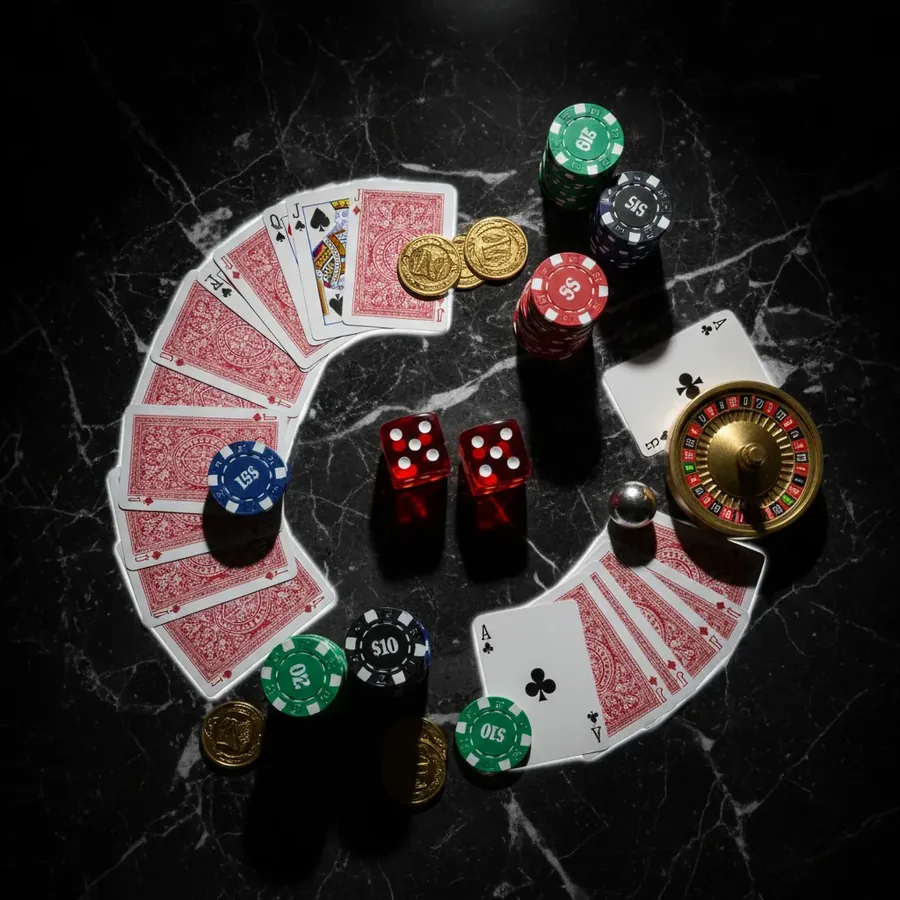
Martingale Fails After 8 Rounds at Table Limit
The Pass Line bet in Craps offers a Return to Player (RTP) of 98.59%, resulting in a house edge of 1.41%. This is considered a favorable bet for players, as the edge is relatively low compared to many other casino offerings. The standard deviation for this bet is 1.00.
The mathematical advantage for the casino on the Pass Line bet is 1.41% on average for each wager placed. While this edge is constant, its impact on a player's bankroll can be amplified through betting systems that aim to recover losses. However, such systems often encounter table limits.
Consider a scenario where a player employs a doubling strategy after each loss. After 8 consecutive losses on a Pass Line bet at a table with a maximum bet of €100, the cumulative bet would exceed the limit, rendering the strategy unsustainable and leading to significant losses.
What Doesn't Count Towards Bonus Wagering on Table Games?
Bets placed on table games at Mad Money contribute only 10% towards meeting bonus wagering requirements. This means that for every €10 bet on a table game, only €1 will count towards the turnover. This contrasts sharply with slot games, which contribute 100%.
For instance, if a player receives a €2,000 welcome bonus with a 40x wagering requirement, they would need to wager €80,000 in total. If all wagering were to be completed on table games, a player would need to bet €800,000 to fulfill this requirement. This is due to the 10% game contribution.
High rollers focusing on table games must be aware of this significant difference in contribution rates. To meet the €80,000 wagering requirement solely through table games, the effective turnover needed is €800,000. This necessitates a much larger volume of play compared to wagering on slots.
What doesn't count: bets over 5 EUR
Bets exceeding €5 on any single wager do not count towards the bonus wagering requirements at Mad Money. This limit applies across all games, effectively capping the contribution of individual bets to the turnover calculation. This rule is crucial for players aiming to clear bonus funds.
For example, if a player makes a €10 bet on a slot game and the bonus wagering is 40 times the bonus amount (€2,000), the maximum €5 of that bet would count. This means only €5 would contribute to the €80,000 total turnover required. The remaining €5 of the bet would not count.
This restriction significantly impacts high rollers who typically place larger bets. A player betting €100 on a single spin of a slot machine would only have €5 counted towards their wagering requirement. This necessitates a substantial increase in the number of bets placed to achieve the required turnover.
Read Statistics of Last 500 Rounds Correctly
The Casino Hold'em game offers a Return to Player (RTP) of 99.18% based on a unit of turnover. The house edge on the Ante bet is 2.16%, with an additional element of risk of 0.82%. This calculation accounts for the player's decision to Call, which is typically double the Ante.
The average bet size in Casino Hold'em, when considering the Ante and Call, is approximately 2.64 times the initial Ante. This leads to a disparity between the stated 2.16% edge on the Ante and the 0.82% edge on the actual amount wagered over time. The Call bet always pays 1:1.
Understanding these figures is vital for high rollers who engage in strategic play. While the overall RTP is high, the nuances of the house edge on different parts of the bet, especially the Ante payouts like Straight (1:1) and Royal Flush (100:1), influence the long-term outcome.
Game categories at a glance
| Category | Examples | Stakes From | Highlight |
|---|---|---|---|
| Slots | Big Bamboo, Temple Tumble Megaways, Gonzo's Quest | 0,10 EUR | thousands of titles |
| Table games | Roulette, Blackjack, Baccarat | 0,50 EUR | classic rules |
| Live casino | Lightning Blackjack, Quantum Roulette | 0,20 EUR | real dealers |
| Jackpot games | Mega Moolah, Divine Fortune, Age of the Gods | 0,20 EUR | progressive pools |
| Instant games | Aviator, Plinko, Mines | 0,10 EUR | fast rounds |
| Video poker | Jacks or Better, Deuces Wild | 0,25 EUR | strategy based |
Roulette Wheel with 37 vs 38 Pockets
European Roulette operates with a wheel featuring 37 pockets, encompassing numbers 1 through 36 plus a single zero. This configuration results in a house edge of 2.70% on all bets. American Roulette, conversely, includes an additional "00" pocket, bringing the total to 38 pockets and increasing the house edge to 5.26%. For high rollers, the distinction is critical as it directly impacts the long-term return on investment.
The mathematical difference between 37 and 38 pockets is significant for players aiming for extended play. A single zero wheel means that payouts, calculated as if there were only 36 sectors, inherently favor the casino by an extra 1/37th of the stakes. This provides a consistent advantage across every wager placed on the table.
Consequently, high rollers prioritizing optimal mathematical conditions should exclusively engage with European or French Roulette variants, as they offer a lower house edge. The presence of the double zero in American Roulette effectively reduces the RTP and increases the house advantage, making it a less favorable choice for strategic play.
Straight, Split, and Corner in direct comparison
A Straight bet in European Roulette, covering a single number, pays 35:1. With 37 possible outcomes, the probability of landing on any specific number is 1 in 37. This payout structure, when compared to the actual odds, contributes to the established 2.70% house advantage on all roulette wagers.
A Split bet, covering two adjacent numbers, offers a payout of 17:1. Similarly, a Corner bet, which covers four numbers, pays 8:1. These bets, while covering more numbers, still have payouts that are mathematically derived from a 36-sector wheel, ensuring the casino's edge remains consistent across these internal bet types.
For a high roller, understanding these payout differentials is key. While a Straight bet offers the highest single-number payout, the lower probability of hitting necessitates a larger bankroll. Conversely, Split and Corner bets provide more frequent, albeit smaller, wins, spreading the risk over multiple outcomes but still subject to the same overall house edge.
Dozen 2:1: Twelve Numbers, One Third Coverage
The Dozen bet in European Roulette covers twelve numbers, such as 1-12, 13-24, or 25-36. This bet offers a payout of 2:1. The probability of winning a Dozen bet is 12 in 37, or approximately 32.43%. This payout is calculated based on a 36-sector wheel, maintaining the casino's 2.70% house advantage.
When considering the coverage, a Dozen bet encompasses exactly one-third of the numbers on the roulette wheel. Despite covering a significant portion of the outcomes, the 2:1 payout means that for every three units wagered on Dozens over time, the casino expects to retain approximately one unit due to the house edge.
High rollers might use Dozen bets for a strategic approach to managing their wagers, aiming for more frequent, smaller wins compared to single-number bets. However, it is crucial to recognize that this bet type, like all others on a European wheel, is designed with the 2.70% house advantage baked into its payout structure.
How Long Does a Roulette Round Take on Average?
The duration of a roulette round is primarily dictated by the speed of the dealer and the players' betting speed, rather than inherent game mechanics. A typical European Roulette spin, from the ball landing to the payout, can take approximately 45 to 60 seconds. This timeframe allows for betting, the spin itself, and settling the wagers.
High rollers often engage with live dealer tables where the pace is controlled by the croupier. While the game mathematics (RTP and house edge) remain constant, the speed of play directly influences the number of rounds played per hour. This, in turn, affects the total amount of money wagered and the cumulative effect of the house edge.
At an average of one minute per round, a player could theoretically complete 60 rounds within an hour. This rate, however, can vary significantly. For high rollers managing substantial bankrolls, the efficiency of play and the number of rounds executed per hour become critical factors in their overall gaming strategy and potential long-term outcomes.
Straight 35:1 Against the Chance of 1 in 37
A Straight bet in European Roulette offers a payout of 35:1 for correctly predicting a single number. This wager covers one specific outcome out of 37 possible pockets on the wheel. The odds of success are precisely 1 in 37, a 2.70% probability.
The payout ratio of 35:1 is intentionally set to be slightly lower than the true odds of 36:1 (37 pockets - 1 winning pocket = 36 losing pockets). This discrepancy is the mathematical foundation of the 2.70% house edge, ensuring that over a vast number of bets, the casino retains a portion of all stakes.
For high rollers, the Straight bet represents the highest risk, highest reward proposition in roulette. While a single win can be substantial, the low probability necessitates a robust bankroll and a clear understanding that the 35:1 payout is structured to favor the casino in the long run, despite appearing favorable at face value.
Soft 17: the Ace counts 11 or 1
In Blackjack, the Dealer Hits Soft 17 rule modifies the dealer's play when holding a hand totaling 17 with an Ace. This rule, which allows the dealer to hit on a soft 17 (Ace and a 6), increases the house edge by 0.22 percentage points compared to a dealer standing on all 17s. For a high roller, this means a slight reduction in potential returns over extended play.
The impact of this rule can be quantified by understanding its effect on RTP. A standard European Roulette game offers an RTP of 97.30%, meaning a house edge of 2.70%. In contrast, the Dealer Hits Soft 17 rule in Blackjack contributes 0.22% to the house edge, pushing the theoretical return closer to the player down.
Understanding these subtle rule variations is crucial for high rollers aiming to optimize their gameplay. For instance, a casino offering liberal Vegas Strip rules with a 3:2 Blackjack payout and standing on all 17s presents a significantly lower house edge of 0.28%. This contrasts with games where the dealer hits soft 17, where the edge can be higher.
Casino Hold'em: Ante Payout Up to 100:1
Casino Hold'em presents an engaging poker variant where players compete against the dealer, with an Ante bet as the primary wager. The game offers substantial payouts on the Ante bet for strong poker hands, including a Royal Flush which can yield a 100:1 return. This high payout potential makes it attractive for players seeking significant wins.
The mathematical structure of Casino Hold'em includes an RTP of 99.18% on the unit of turnover, with a house edge of 2.16% on the Ante and a 0.82% element of risk. This calculation considers the player's decision to call or fold after the flop, with the average bet size being 2.64 times the Ante.
For a high roller, the allure of Casino Hold'em lies not just in the main payouts but also in the strategic element of the game. A well-timed Call, combined with a strong Ante payout, can lead to significant returns, especially when considering the bonus payouts for hands like a Straight Flush at 20:1 or a Four of a Kind at 10:1.
Why the Double Zero Almost Doubles the House Edge
The presence of a double zero (00) in American Roulette significantly alters the game's mathematical profile compared to its European counterpart. While European Roulette features a single zero (0) on its wheel, American Roulette includes both 0 and 00, resulting in 38 numbered pockets instead of 37.
This additional zero pocket directly impacts the house edge on all bets. For instance, the Five Number Bet on American Roulette, covering 0, 00, 1, 2, and 3, carries a substantial house edge of 7.89%. This is considerably higher than the standard edge on most bets in European Roulette, which remains at 2.70%.
The impact on high rollers is substantial; a higher house edge means that, on average, a larger portion of wagers will be retained by the casino over time. Opting for European Roulette, with its single zero, is therefore a more financially prudent choice for players prioritizing lower risk and a better RTP, which stands at 97.30%.
Three Roulette Variants, Three House Edges Compared
Roulette offers several variations, each with distinct mathematical underpinnings that affect the house edge. European Roulette, characterized by a single zero (0), presents a consistent house edge of 2.70% across all standard bets. This includes even-money bets like Red/Black or Odd/Even, which pay 1:1.
American Roulette, conversely, features both a single zero (0) and a double zero (00), leading to a higher house edge of 5.26% on most bets. However, the Five Number Bet (0, 00, 1, 2, 3) stands out with an even greater house edge of 7.89%, making it a less favorable option for discerning players.
French Roulette, while mathematically similar to European Roulette with a 2.70% house edge, offers the 'La Partage' or 'En Prison' rule for even-money bets. This rule effectively halves the house edge on even-money bets when the ball lands on zero, reducing the overall house advantage to approximately 1.35% for these specific wagers.
Columns and Dozens Pay 2:1 in Roulette
In the realm of European Roulette, bets on either a Column or a Dozen offer attractive payouts. These bets cover 12 numbers each, providing players with a wider spread of potential wins. The payout structure for these bets is set at 2:1, meaning a winning wager returns twice the original stake plus the initial bet.
These bets contribute to the overall house edge of 2.70% inherent in European Roulette. While the 2:1 payout is favorable for covering a significant portion of the wheel, it is calculated to maintain the casino's advantage over the long term. For example, a bet on the first dozen returns €3 for every €1 wagered if successful.
For high rollers, understanding the implications of these bets is vital. While the 2:1 payout on Columns and Dozens offers a reasonable return, it's essential to compare this with other bet types. For instance, a Straight bet on a single number pays 35:1, offering a much higher potential payout but with a significantly lower probability of winning.
Contact
Live - online chat
Banking









Providers












Mad Money Casino 2026